.png?w=204&h=18)

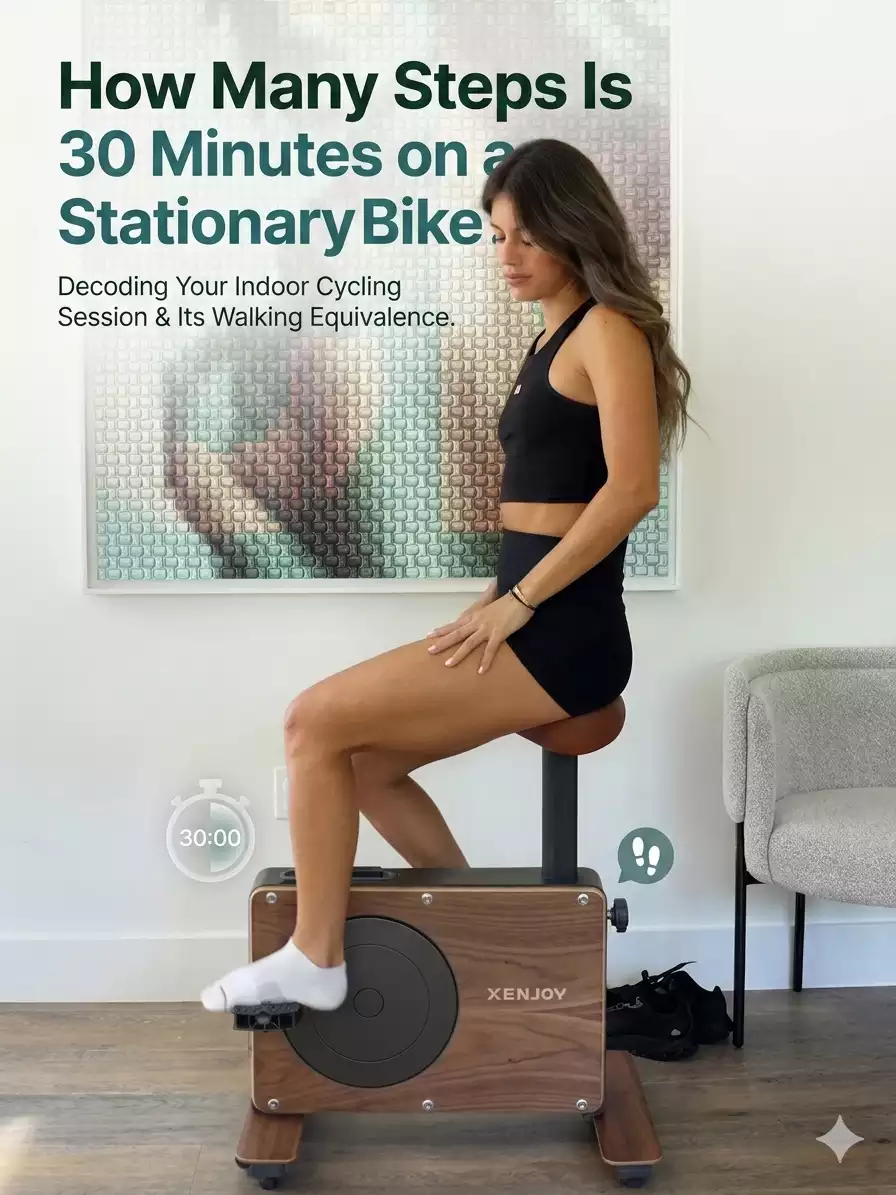
If you're tracking daily steps but prefer cycling, you've probably wondered how your stationary bike workouts stack up against walking. Since your feet never hit the ground while cycling, fitness trackers don't count those pedal strokes—but that doesn't mean you're not putting in the work.
We'll walk you through the exact conversions, explain why the numbers vary, and show you how to track your cycling sessions accurately so you can hit your fitness goals with confidence.
The Quick Answer: 3,000 to 8,000 Steps
30 minutes on a stationary bike typically equals between 3,000 and 8,000 steps. The wide range depends on your workout intensity, resistance level, and pedaling speed.
At a leisurely pace with minimal resistance, you'll land closer to 3,000-4,000 steps. A moderate workout with steady resistance puts you around 4,000-6,000 steps. Push into high-intensity territory with challenging resistance and faster cadence, and you'll hit 6,000-8,000 steps or more.
Here's what makes cycling different from walking: your fitness tracker measures vertical impact and arm swing. Since cycling keeps your feet stationary on the pedals, these devices assume you're standing still—even when you're working hard.
Why Intensity Changes Everything
The resistance you set on your bike matters more than you might think. Increasing resistance by just 2-3 levels can boost your step equivalent by 15-20% without changing your speed.
Low-intensity cycling (50-60 RPM with minimal resistance) feels similar to casual walking. You can maintain this pace comfortably for long periods, and it's perfect for recovery days or warm-ups.
Moderate-intensity cycling (60-80 RPM with steady resistance) mimics brisk walking or light jogging. You should be able to hold a conversation, though your heart rate will climb. Most people work in this range for regular cardio sessions.
High-intensity cycling (80+ RPM with challenging resistance) creates cardiovascular demand similar to running. At this level, talking becomes difficult, and you'll feel the burn quickly. This intensity delivers the highest step equivalent per minute.
Converting RPM to Steps
Most stationary bikes display RPM—revolutions per minute, or how many times you complete a full pedal rotation in 60 seconds. You can use RPM as a baseline for step conversion.
The simplest method multiplies your pedal revolutions by 2 to estimate step equivalents. So if you pedal at 60 RPM for 30 minutes, you complete 1,800 revolutions. Multiply that by 2, and you get roughly 3,600 steps.
At moderate resistance, some experts suggest multiplying RPM by 3 for a more accurate conversion. Using this method, 60 RPM over 30 minutes would equal 5,400 steps (1,800 revolutions × 3).
The multiplier changes based on effort level. Low resistance uses a 2× multiplier, moderate resistance uses 3×, and high resistance might warrant even higher multipliers. Track your own patterns to find what works best for your workout style.
Comparing Calories: Cycling vs. Walking
A 155-pound person burns about 260-311 calories cycling at moderate intensity for 30 minutes, compared to 133-149 calories walking at a brisk pace for the same duration. Cycling often delivers more cardiovascular benefit in less time.
This efficiency makes stationary bikes valuable for people with limited workout time. You're getting roughly double the calorie burn compared to walking, which means you can achieve similar fitness results in half the duration.
Cycling also offers joint-friendly cardio. The low-impact nature means less stress on knees, ankles, and hips—a real advantage for people managing joint issues or recovering from injuries. If you're looking to add purposeful movement to your daily routine, a compact option like the XENJOY Cube Under Desk Cycle brings refined design and real wood accents to spaces under 3.2 square feet, fitting seamlessly into home offices or living areas.
Using Conversion Charts and Apps
Several fitness organizations publish step conversion charts based on metabolic equivalents (METs). These charts estimate that stationary cycling at light intensity equals about 170 steps per minute, moderate intensity equals 228 steps per minute, and vigorous intensity equals 361 steps per minute.
Multiply the steps-per-minute rate by your workout duration. For a 30-minute moderate session: 228 steps/minute × 30 minutes = 6,840 steps.
Many fitness trackers now include cycling modes that automatically convert your ride into step equivalents. Devices from Fitbit, Apple Watch, and Garmin sync with apps that track cycling distance, speed, and calories, then translate those metrics into estimated steps.
Apps like Strava and MapMyFitness also offer built-in conversion tools. You can manually log your cycling sessions, and the app will apply its conversion formula to credit your step count for challenges or daily goals.
Reaching the 10,000-Step Goal
The popular 10,000-step daily target dates back to 1960s Japan, when Dr. Yoshiro Hatano's research suggested this number promoted better health. While the specific number isn't magic, it represents roughly 5 miles of walking and serves as a useful benchmark.
If you're cycling instead of walking, you can hit 10,000 steps with about 60-70 minutes of moderate-intensity riding. At higher intensities, you might reach this goal in 50 minutes or less.
You don't need to choose between cycling and walking. Many people mix both activities throughout the week, using cycling for efficient cardio sessions and walking for lower-impact movement on recovery days. Both contribute to your overall activity level and cardiovascular health.
Making Conversions Work for You
Track your baseline by noting your typical RPM and resistance settings. After a few sessions, you'll develop a feel for how many "step equivalent" minutes you're logging.
Be consistent with your tracking method. Whether you use RPM multipliers, conversion charts, or fitness apps, stick with one approach so your data remains comparable over time.
Don't obsess over perfect accuracy. Step conversions from cycling are estimates based on energy expenditure, not literal footfalls. The goal isn't mathematical precision—it's tracking your overall movement patterns and staying motivated.
Focus on progression. If you're consistently cycling 30 minutes and want to increase your activity, either extend your duration, boost your resistance, or add interval training. All three approaches will raise your step equivalent.
Conclusion
30 minutes on a stationary bike translates to 3,000-8,000 steps, with the range determined by your intensity and resistance settings. While cycling doesn't register on traditional step counters, you can accurately track your efforts using RPM conversions, published conversion charts, or fitness apps with cycling modes.
Cycling delivers efficient calorie burn and low-impact cardio—often outperforming walking in terms of cardiovascular benefit per minute. Whether you're working toward a 10,000-step goal or just trying to stay active, stationary bike workouts count. Track them consistently, adjust for intensity, and remember that all movement contributes to your health.
FAQs
Is cycling as good as walking for daily steps?
Cycling burns more calories per minute than walking and provides excellent cardiovascular benefits. While it doesn't create literal steps, the energy expenditure and health benefits often exceed those of walking for the same duration. Both activities support heart health and fitness—choose based on your preferences and physical needs.
How do I track stationary bike workouts if my fitness tracker doesn't count steps?
Most modern fitness trackers include a cycling mode that estimates steps based on time, intensity, and heart rate. Alternatively, multiply your cycling minutes by a conversion factor: 170 steps/minute for light intensity, 228 for moderate, or 361 for vigorous. Apps like Strava and MapMyFitness also convert cycling sessions automatically.
Does resistance matter for step conversion?
Yes, significantly. Higher resistance increases the energy you expend per pedal stroke, which raises your step equivalent. Bumping up resistance by 2-3 levels can increase your step conversion by 15-20% without changing your speed. This makes resistance one of the most effective ways to maximize your workout's step value.
Can I lose weight cycling 30 minutes daily instead of walking 10,000 steps?
Absolutely. A 155-pound person burns 260-311 calories during 30 minutes of moderate cycling, compared to about 150-200 calories walking 10,000 steps. Cycling's higher calorie burn makes it time-efficient for weight loss, especially when combined with proper nutrition and consistency.
Should I use 2x or 3x when converting RPM to steps?
It depends on your resistance level. Use 2× for low resistance and leisurely cycling, 3× for moderate resistance with steady effort, and potentially higher multipliers for vigorous intensity. Test different multipliers against how your body feels and your heart rate to find the most accurate conversion for your workouts.

.png?w=158&h=18)